


A study conducted by a multidisciplinary team of Italian researchers has unraveled the mysteries of the materials and advanced construction techniques that allowed the Temple of Venus, a jewel of Roman architecture in the Phlegraean Fields (Italy), to withstand the passage of two millennia. The research, published in the journal Geoheritage, combines macroscopic analysis with petrographic and mineralogical techniques to provide a detailed picture of Roman engineering and craftsmanship.
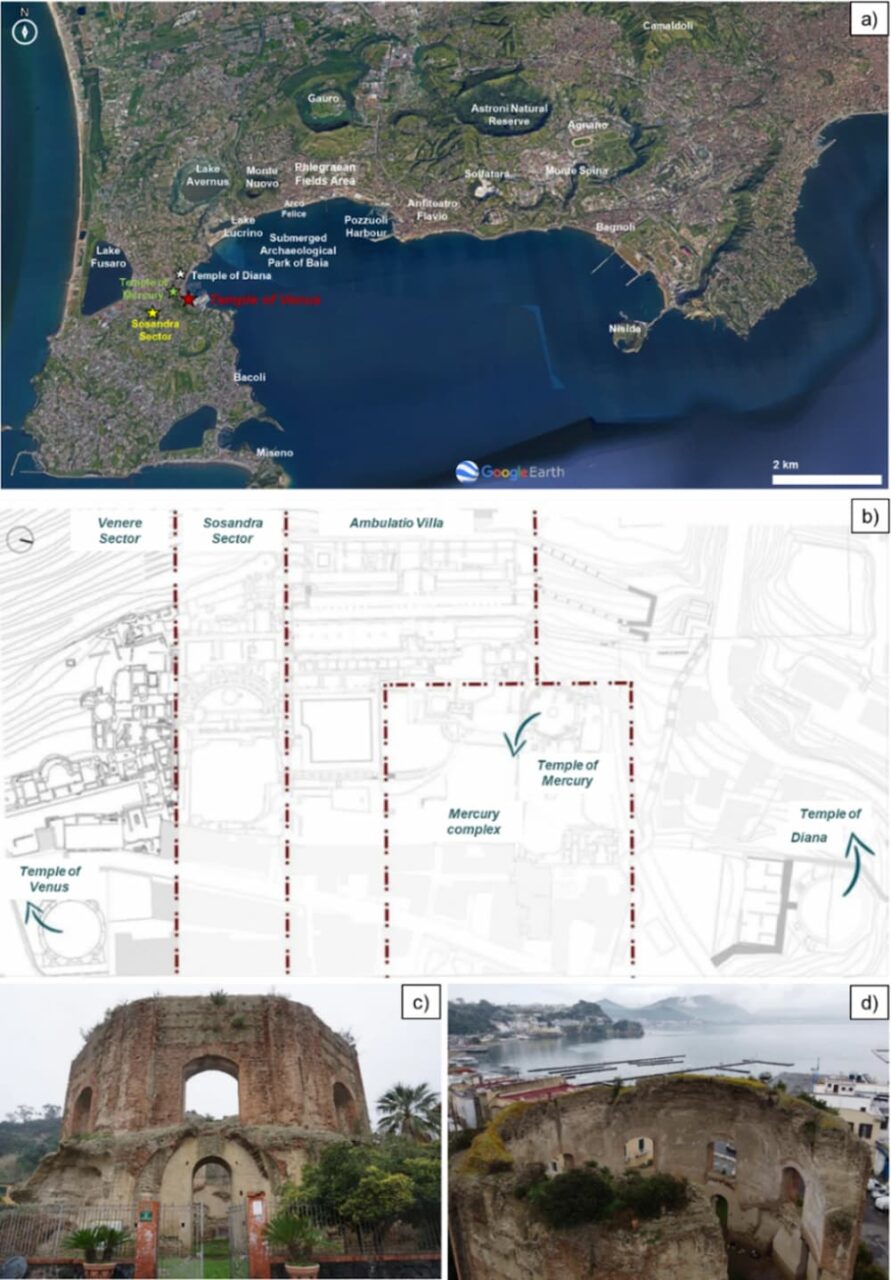
The Temple of Venus, located in the area of Baiae, was not a conventional temple but the natatio or main pool of a vast thermal complex built in the 2nd century CE by order of Emperor Hadrian most of which now lies about six meters below the current surface, a victim of the phenomenon of bradyseism, characteristic of this volcanic region. Its design is unique: octagonal on the exterior, circular on the interior, and crowned by an umbrella-shaped dome.
For this study, the researchers, in collaboration with the Archaeological Park of the Phlegraean Fields, took nine representative, low-visual-impact samples from the building. The selection included: 3 types of mortars, 2 brick fragments, a piece of volcanic scoria, a tuff sample, a lava building stone, and a salt efflorescence sample.
These samples were analyzed using optical microscopy and X-ray diffraction, techniques that allow researchers to identify minerals and the texture of materials at the microscopic level.
The findings: local materials and Roman ingenuity
The results paint a fascinating picture of the supply chain and Roman construction technology.
The analysis confirmed that the Roman mortars of the Temple of Venus are lime-based. However, their real secret is not the lime itself but the volcanic aggregate mixed with it. This aggregate, composed primarily of pumice and other volcanic fragments, reacts chemically with the lime in the presence of water, creating an extraordinarily strong and durable material known as hydraulic mortar. This reaction, called pozzolanic, is responsible for the survival of these structures to this day.
The researchers observed under the microscope intense carbonation features and clear reaction rims in the pumice, direct evidence that this chemical reaction occurred. In addition, the presence of small lumps of unreacted lime suggests that the mixing or slaking process was occasionally imperfect.

The [aggregate’s] provenance is linked to its local origin, attributed to the Neapolitan Yellow Tuff of the Phlegraean Fields, the study states. The lime, for its part, is hypothesized to have been produced with local materials from the Campanian plain.
The bricks analyzed show a similar composition: a mixture of fired clay with inclusions of quartz, mica, and volcanic fragments. The presence of hematite is what gives them their characteristic red color. A key finding is that the ceramic matrix shows moderate optical activity, indicating that the firing temperature, although high (around 800°C), was not sufficient to fully decompose the clay fraction.
The combination of a silico-clastic fraction (typical of fluvial sediments) with a volcanic fraction is genetically incompatible in nature. This leads the researchers to conclude that the Romans either used clays that had already been transported and mixed by sedimentary processes or deliberately added volcanic material (the “temper”) to the clay to improve the properties of the brick.
Vesuvian Scoria: imported material to lighten the structure
One of the most significant discoveries concerns the volcanic scoria. This extremely vesiculated and lightweight material was used in the upper part of the temple. The Romans employed it strategically to support the weight without risking collapse, adding lightness to the facing mortar with which it is in contact.
Mineralogical analysis was crucial: the presence of leucite is an unequivocal indicator that this scoria is not local to the Phlegraean Fields but is of Vesuvian origin. This shows that, despite being in the heart of a volcanic region like the Phlegraean Fields, Roman engineers did not hesitate to import specific materials from another volcanic area, Vesuvius, about 30 km away, when structural needs called for it. This construction technique made it possible to build structures that are still perfectly preserved today, the article emphasizes.
The tuff used in the temple is indeed local. Its mineralogical association, with the presence of alkali feldspars and zeolites such as phillipsite and chabazite, links it directly to the formation of the Neapolitan Yellow Tuff of the Phlegraean Fields.
Similarly, the analyzed lava stone has a trachytic texture and a mineral composition (with clinopyroxene, plagioclase, and alkali feldspar) characteristic of the products of the Phlegraean Fields. The absence of leucite in this sample definitively rules out a Vesuvian origin.
The Efflorescence: the trace of time and humidity
The white, powdery sample turned out to consist solely of halite, that is, common salt (NaCl). These efflorescences are a symptom of deterioration caused by rising moisture that dissolves the salts present in the materials and deposits them on the surface as the water evaporates. Their presence is particularly relevant when planning future restoration efforts.
The builders of the Temple of Venus demonstrated a deep empirical understanding of the geological materials at their disposal. They knew how to select the most suitable local rocks (Phlegraean tuff and lava), how to produce a high-performance hydraulic mortar using pozzolanic aggregates, and how to combine clays to produce effective bricks. They were even able to identify a specific material—Vesuvian scoria—in a different volcanic region and import it to solve a concrete structural challenge: lightening the upper sections of the construction.
The study concludes unequivocally: This research highlights the mineralogical, petrological, and structural characteristics of the materials used to build the Temple of Venus and provided new insights into the technical skills achieved by the ancient Romans, and how their production technology was oriented toward innovation, quality, sustainability, durability, and, not least, beauty.
The research lays a crucial scientific foundation for future restoration and conservation work on this emblematic monument, ensuring that Roman ingenuity, now better understood, continues to inspire admiration for generations to come.
SOURCES
Rispoli, C., Montesano, G., Antonini, R. et al. Innovative Roman Building: Geomaterials, Construction Technology and Architecture of the Roman Temple of Venus (Phlegraean Fields, Italy). Geoheritage 17, 163 (2025). doi.org/10.1007/s12371-025-01208-z